
NEET UG Physics Syllabus 2025 contains theoretical and numerical problems that require strategical planning and focused preparations. The NEET UG 2025 syllabus for Physics cover all topics from Class 11 and Class 12, mostly from the NCERT books. This article gives overview about weightage of topics and unit-wise divisions of syllabus so candidates can determine key areas to focused on for revisions.
Candidates need to also be familiar with practical applications because questions often combine theory and real-world scenarios. Practicing these concepts deeply and consistent practicing of numericals along with mocks tests leads candidates to succeed in the physics section of NEET UG examination.
Contents
Weightage
The NEET UG 2025 Physics syllabus include concepts from Class 11 and 12. It includes topics like Mechanics, Thermodynamic, Electricity, Magnetism, Optics and Modern Physics etc. NEET Physics focuses on applying understanding and solving problems, so candidates need deep knowledges of every concepts. The syllabus mostly take reference from NCERT textbooks and proper preparations should ensures covering each units.
This article presents topics, unit-wise, subject-wise weightage and useful tips for effective preparation.
From Class 11
Below is the table mentioning the class 11 physics syllabus-
| Chapter | Weightage | Topics Covered |
| Physical World and Measurement | 5% | – Introduction to the scope of Physics, units and measurements – Physical quantities and error analysis |
| Kinematics | 10% | – Motion in one and two dimensions – Graphical representation of motion, velocity, acceleration |
| Laws of Motion | 10% | – Newton’s laws of motion, applications – Friction and circular motion |
| Work, Energy, and Power | 10% | – Work-energy theorem and its applications – Conservation of mechanical energy – Power and energy transfer |
| Motion of System of Particles and Rigid Body | 10% | – Centre of mass, collision and impulse – Rotation of rigid bodies, angular momentum and torque |
| Gravitation | 5% | – Universal law of gravitation, Kepler’s laws – Gravitational potential energy |
| Properties of Bulk Matter | 6% | – Surface tension and viscosity – Elasticity, bending of beams |
| Thermodynamics | 10% | – Laws of thermodynamics – Thermal expansion and heat engines |
| Perfect Gas Behavior and Kinetic Theory | 4% | – Gas laws and kinetic theory of gases |
| Oscillations and Waves | 5% | – Simple harmonic motion (SHM) and wave motion – Speed of sound and Doppler effect |
From Class 12
Below is the table mentioning the class 12 physics syllabus-
| Chapter | Weightage | Topics Covered |
| Electrostatics | 9% | – Electric charge, electric fields, Gauss’s law – Electrostatic potential and energy |
| Current Electricity | 10% | – Electric current, Ohm’s law, electrical resistance – Kirchhoff’s laws and application in circuits |
| Magnetic Effects of Current and Magnetism | 10% | – Magnetic fields, Ampere’s law, and Biot-Savart law – Ferromagnetic and paramagnetic properties of materials |
| Electromagnetic Waves | 5% | – Nature and properties of electromagnetic waves – Electromagnetic spectrum and uses |
| Optics | 7% | – Reflection and refraction at spherical mirrors and lenses – Wave optics, interference, diffraction and polarization |
| Dual Nature of Matter and Radiation | 5% | – Photoelectric effect and de Broglie concept of matter waves |
| Atoms and Nuclear | 7% | – Atomic structure, Bohr’s model – Radioactivity, nuclear fission and fusion |
| Electronics | 7% | – Semiconductor devices, diodes, transistors and logic gates – Communication systems |
| Mechanical Waves and Sound | 4% | – Properties of waves and sound waves – Speed of sound in different media |
| Alternating Current | 6% | – AC circuits and resonance – LC oscillations and power in AC circuits |
Chapter-Wise Partition
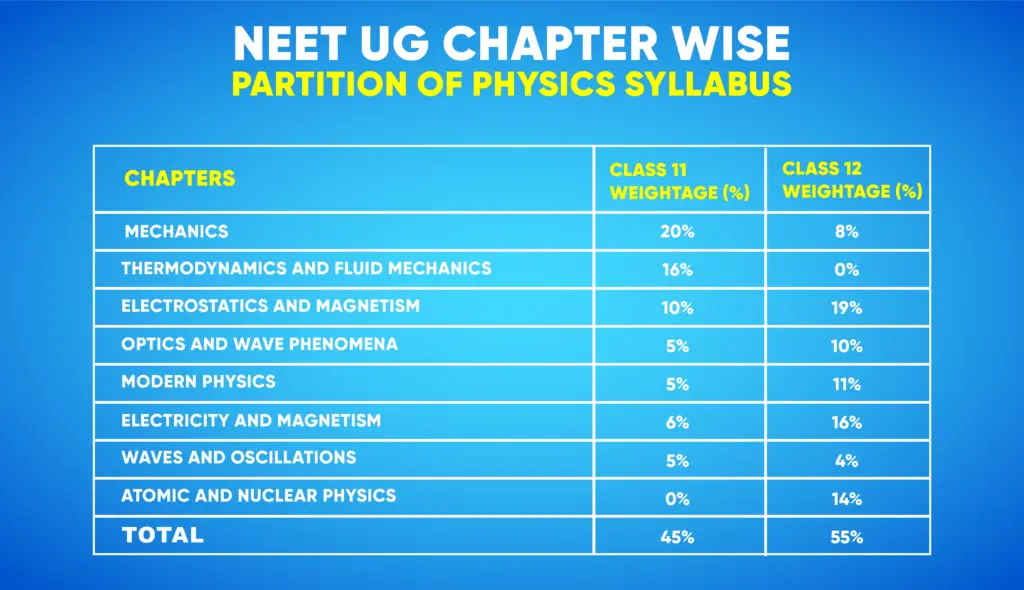
This syllabus has been designed so that students will have to be strong in both conceptual knowledge and in solving numerical problems. Below is the estimated unit-wise weightage of NEET Physics that shows the key areas of focus of each class:
| Chapters | Class 11 Weightage (%) | Class 12 Weightage (%) |
| Mechanics | 20% | 8% |
| Thermodynamics and Fluid Mechanics | 16% | 0% |
| Electrostatics and Magnetism | 10% | 19% |
| Optics and Wave Phenomena | 5% | 10% |
| Modern Physics | 5% | 11% |
| Electricity and Magnetism | 6% | 16% |
| Waves and Oscillations | 5% | 4% |
| Atomic and Nuclear Physics | 0% | 14% |
| Total | 45% | 55% |
Unit-Wise Weightage
Here is the detailed table for topic-wise syllabus weightage of Physics for NEET UG 2025. Class 11 Topics covers 45–50% of the Physics section and class 12 Topics covers 50–55% of the Physics section. It is to be noted that the exact weightage can vary slightly year after year but it gives an idea of how different sections are usually divided.
| Topic | Unit | Estimated Weightage (%) |
| Mechanics | Kinematics | 6-8% |
| Laws of Motion | 4-6% | |
| Work, Energy, and Power | 4-6% | |
| System of Particles and Rotational Motion | 6-8% | |
| Gravitation | 2-4% | |
| Properties of Bulk Matter | 2-4% | |
| Thermodynamics | Thermodynamics and Heat | 6-8% |
| Kinetic Theory of Gases | 1-2% | |
| Electrostatics | Electrostatics | 7-9% |
| Capacitance | 2-3% | |
| Current Electricity | Current Electricity | 3-5% |
| Magnetic Effects of Current & Magnetism | Magnetic Effects of Current and Magnetic Fields | 5-7% |
| Magnetism and Matter | 2-3% | |
| Electromagnetic Induction | Electromagnetic Induction | 4-6% |
| Alternating Current | Alternating Current | 3-5% |
| Optics | Ray Optics and Optical Instruments | 7-9% |
| Wave Optics | 3-5% | |
| Modern Physics | Dual Nature of Matter and Radiation | 3-5% |
| Atoms and Nuclei | 5-7% | |
| Electronic Devices | 3-5% | |
| Electromagnetic Waves | Electromagnetic Waves | 1-2% |
| Communication Systems | Communication Systems | 1-2% |
The current trends shows that subjects like Mechanics, Thermodynamics, Electrostatics and Modern Physics often have more weightage in NEET UG 2025. Concentrate on both theory and practice problems to ensure well-balanced preparation.
Tips for Preparation
Following are the tips for the candidates who are preparing for NEET UG Physics.
- Study with NCERT Text Books with Proper Understanding: Physics for NEET UG is built on the topics of NCERT books. Concepts from the syllabus are taken directly from these books so focus on detailed reading and practice the example problems.
- Important Chapters: Some topics always cover high weightage. Which includes Mechanics (Kinematics, Laws of Motion), Electrostatics, Thermodynamics, Optics and Atomic & Nuclear Physics.
- Conceptual Clarity: Before jumping into numerical problems, make sure that the basic concepts and formulas are clear. NEET UG is not about test calculation skills but also an understanding of principles like conservation of energy, laws of motion, etc.
- Practice different type of Problems: Regular solving of numerical problems and conceptual MCQs from previous year papers helps develop both speed and accuracy.
- Time Management: Dividing your preparation into manageable parts and following a timetable helps to cover all the topics. Regular mock tests can increase your time-management skills during the actual exam.
- Regular Revision: Physics involves both concepts and formulas, so constantly revising what you’ve learned is crucial for better learning.
Frequently Asked Questions(FAQ’s)
What is the weightage of Physics in the NEET UG 2025 exam?
Physics typically carries 180 marks out of the total 720 marks in the NEET UG exam. This means Physics accounts for 25% of the total exam score. The paper consists of 50 questions (35 in Physics and 15 in Chemistry and Biology each).
How much weightage does Modern Physics have in the NEET UG Physics section?
Modern Physics including topics like the Photoelectric effect, Atomic structure and Nuclear Physics, holds significant weightage, typically contributing around 10–12% (5–6 questions). It is a high-scoring area, so focusing on these topics can be beneficial.
Is the topic of Fluid Mechanics important for NEET UG 2025?
Fluid Mechanics is an important topic in Mechanics and usually contributes around 5–7% of the Physics syllabus (2–3 questions). Key concepts like fluid flow, Bernoulli’s principle and viscosity are important areas to focus on.